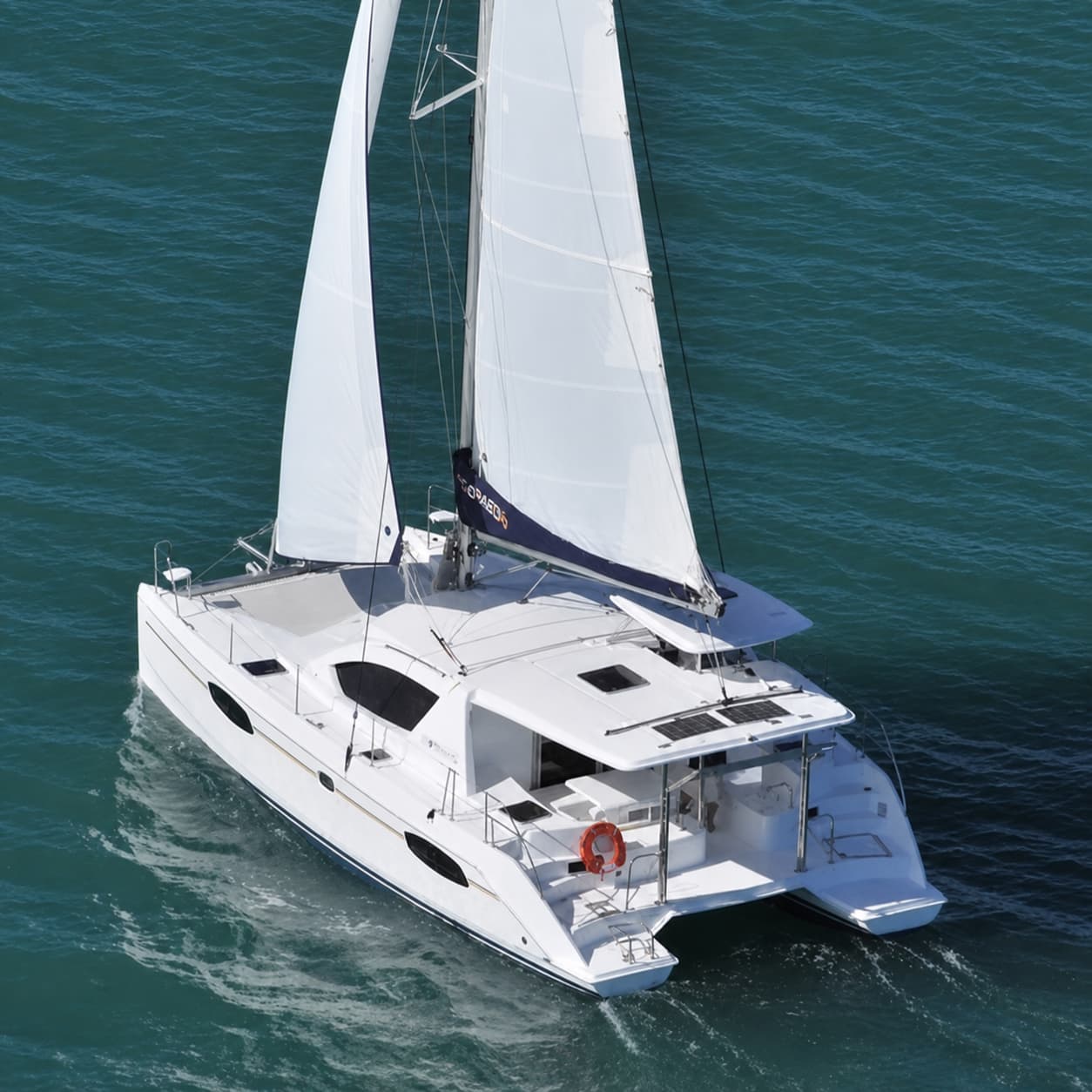
Family Yacht Charter in Phuket: Booking a Catamaran with Kids
A day at sea with your kids in Phuket can be the best day of the holiday — or the one you remember with a sigh. The difference usually isn't the children. It's the boat and the route their parents picked.
Here's the practical breakdown: why a catamaran beats a speedboat for families, which routes a three-year-old can actually handle, what's genuinely worth packing, and what to know before you book.
Why a catamaran rather than a speedboat
Phuket offers three main formats for a day on the water: the group speedboat, the big ferry, and a private catamaran. For a family with small children, the difference matters more than you'd expect.
Stability. A catamaran sits on two hulls, so the motion is noticeably gentler than on a single-hull boat. For a child prone to seasickness this is often the deciding factor — the same crossing on a speedboat turns into an ordeal.
Speed and slamming. A speedboat runs fast and literally slams into every wave. Adults call it a thrill; children find it frightening and physically uncomfortable. A catamaran runs slower and smoother — you'll reach Koh Hey in an hour rather than twenty minutes, but everyone arrives in a good mood.
Space. On a speedboat you sit on your bench all day. On a 39–47ft catamaran there's a deck where a child can walk around, lie down, play and nap in the shade. Across a five- to nine-hour trip, those are two different worlds.
Shade. An underrated point. Tropical sun is harsher on the water than on the beach — it reflects off the surface and hits you twice. Being able to move a child into shade at any moment matters more than an extra stop on the itinerary.
Your group and nobody else. On a group tour you'll be one of forty people on a fixed schedule with lunch served by the clock. On a private charter the day bends around your child: if they need to sleep, you sit at anchor instead of racing to the next stop.
Safety: what to know before you book
After several serious incidents involving tourist boats, Thailand tightened its marine rules considerably. All passengers are required to wear life jackets at all times while on board, port officials check operator licences and passenger numbers against limits, and a red and green flag system warns operators about weather conditions.
What that means in practice:
Check the operator's licence. Commercial vessels must hold valid licences and documented safety protocols; operating without one attracts fines, and authorities actively enforce this in busy tourist zones. A legitimate company will show you the paperwork without hesitation.
Children's life jackets deserve their own paragraph. Adult jackets are on every boat, but child sizes are often in limited supply. Charter companies openly recommend bringing your own jacket for your child — that way it fits correctly and is comfortable for them. An adult jacket on a five-year-old rides up in the water and won't support their head. This isn't a formality; it's a real risk.
If you don't have your own, tell the operator your children's ages and weights when you book, not on the morning of the trip. Our booking form has a comments field for exactly this — tell us how old the kids are and we'll have the right sizes ready.
A red flag means no. If the port is closed for weather on the day, the trip doesn't go out. That isn't fussiness or an excuse to spoil your plans — in July 2018 a vessel carrying 105 tourists sank in a storm near Koh Racha and 47 people died. The flags have been taken seriously ever since, and rightly so.
The "one hand for the boat" rule. A simple piece of seamanship worth teaching your child in the first few minutes aboard: when the boat is moving, one hand always holds a rail. It works better than ten separate warnings.
Which routes work for children
The key factor is how long the crossing takes, not how beautiful the destination is. A child who's spent two hours bouncing across open water won't appreciate the most photogenic bay in the Andaman.
Excellent for young children
Koh Hey (Coral Island) — the closest island to Phuket, so the shortest crossing. Gentle entry into the water, a sheltered bay, and reef starting close to shore. The ideal first boat trip for a family with toddlers.
Koh Maithon — also nearby, calm water, and dolphins are a regular sight on the way. Fewer people than Koh Hey.
Both are available as half-day trips (08:00–13:00) — more on that below.
Good from around age 6–7
Koh Racha Yai — a longer crossing, but the clearest water in the area and by far the better snorkeling. Children who already swim confidently get the most out of this one.
Sunset programs (14:00–19:00) — an afternoon departure means your child naps at the hotel first and reaches the boat in the softest light of the day. Often a better fit for families than an early start.
Think twice
Koh Phi Phi — the program runs 08:00 to 20:00. Twelve hours is a very long day for a child under 8 or 9, and Maya Bay itself is currently viewable only from the water: from 1 August to 30 September 2026 landings on the beach are closed, and the bay can only be seen from on board. If Phi Phi with kids is a must, save it for when they're older.
The half-day: an underrated format for families
Parents often default to the full day — "if we're paying anyway, let's get the most out of it." With small children this is almost always a mistake.
A half-day program runs five hours (08:00–13:00 or 14:00–19:00). That's enough time for a child to swim, try a mask and snorkel, and mess about on the paddle board — and not enough time to get exhausted, sunburnt and miserable. You come back ashore with energy left, rather than carrying a sleeping child off the boat.
The morning option gets you on the water before the heat and before most of the boat traffic. The afternoon-and-sunset option means nobody has to wake a four-year-old at 7am.
The price difference is real: a half day on Seraphina starts at 13,000฿ for the whole boat, a full day at 21,000฿.
Food on board
Drinking water, soft drinks, fruit and ice are included in every charter — enough to keep children going on a shorter trip.
A proper meal is booked separately: Thai food at 350฿ per person, seafood at 650฿ per person, with a minimum order of 10 people. For a family of four that makes a full catered lunch poor value, so bringing your own food usually makes more sense.
A practical note: children rarely want a serious sit-down meal at sea anyway. Cut fruit, bread and simple familiar things work far better. And bring more water than you think you need — in the sun and salt water, kids dehydrate faster than adults.
If a child has allergies or specific dietary needs, put it in the comments when you book.
What to pack
A child's life jacket — if you own one, bring it
SPF 50+ sunscreen, ideally reef-safe, reapplied every two hours
A UV swim shirt (rash guard) — more reliable than any sunscreen, and a child can swim in it for hours
Hat and sunglasses
Towels — there are towels on board, but your own are familiar
A dry change of clothes for the ride home: the wind picks up in the evening and a wet child gets cold
Shoes you don't mind soaking — some stops have rocky entries
Motion-sickness remedy if your child is prone to it, given 30–40 minutes before departure
A power bank — phones in camera mode die by lunchtime
If grandparents are coming too
Multigenerational trips have become one of the clearer trends in chartering: families increasingly take a whole boat so everyone can be together. Sometime takes up to 25 guests, so a large family fits on one deck without compromises.
A few honest points worth knowing in advance:
There is no air conditioning on either Sometime or Seraphina. That's deliberate — open deck, shade sail and sea breeze instead. Most guests prefer it, but if older relatives struggle with heat, choose a morning or sunset departure rather than midday.
Boarding involves a step from the pier onto the boat. The crew helps, but anyone with significant mobility limitations should mention it in advance so we can advise on the pier and the tide timing that will be easiest.
There is a toilet on board, though it's compact, as on any yacht this size.
Shade — both boats have shaded seating areas fore and aft, with room for everyone.
What it costs
Prices are per boat, not per person — that's the whole economics of a family charter.
For a family of four to six this works out comparable to buying group tour seats for everyone — except you get the entire boat to yourselves.
Booking takes a 50% deposit, with the balance due 2 days before departure. Cancellation a week or more ahead is free of charge.
Frequently asked questions
What's the minimum age for a child on a yacht? There's no hard limit. Families regularly bring two- and three-year-olds on the short programs — half-day trips to Koh Hey or Koh Maithon. For longer routes like Phi Phi, waiting until around 8 or 9 makes more sense.
What if my child gets seasick? Choose a catamaran over a speedboat and a short route. Seat them nearer the centre of the boat where the motion is least, and keep them looking at the horizon rather than down at a phone. Give any motion-sickness remedy 30–40 minutes before departure, not once they already feel unwell.
Are children's life jackets available on board? Yes, but the range of sizes is limited — tell us your children's ages and weights when booking so we can prepare the right ones. If you have your own jacket, bring it.
Can we change the route on the day? On a private charter, yes — within reason and within what the weather allows. If your child has had enough you can head back early; if everyone's happy at a snorkel stop you can stay longer. That flexibility is the main point of going private.
What happens if the weather is bad on the day? If the port is closed for weather, the trip is postponed or cancelled — we don't take chances with this. Rescheduling terms are handled case by case.
Can we bring a stroller? Onto the boat, there's no point — it takes up space and does nothing useful. To the pier, yes; leave it in the car or at the office.
In short
For families with children in Phuket the formula is straightforward: a catamaran rather than a speedboat, a short route rather than a spectacular one, and a half day rather than a full one. Koh Hey and Koh Maithon cover what most families with young kids need; Koh Racha is the step up for older children.
Tell us your children's ages in the comments when you book — we'll match the route and departure time to them, and have the right life jackets ready.